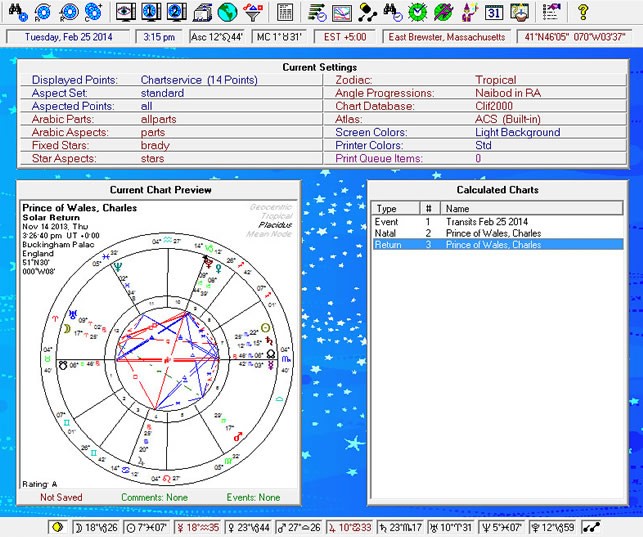
A Solar Return chart is drawn for the exact moment the Sun returns to its natal position (i.e. same degree, minute, and second) each year. This chart offers insights into the themes, challenges, and opportunities for the coming year. One of its key components is the aspects — angular relationships between planets within the Solar Return chart. The way planets interact via aspects shapes the flavor and dynamics of the year ahead.
Below is a structured guide to Solar Return aspects and their interpretations.
1. Importance of Aspects in Solar Return Charts
- Aspects show how the planetary energies in the Solar Return year will combine, conflict, or support each other.
- They indicate where tension, easy flow, transformation, or stagnation may occur.
- Strong, exact aspects carry more weight in forecasting.
- Minor aspects (semi-sextile, quincunx, etc.) can provide nuance or side-themes.
2. Major (Classical) Aspects & Their Meanings
Aspect | Angle | Qualities / Nature | Interpretive Keywords | Possible Effects |
|---|---|---|---|---|
| Conjunction | 0° | Unity, fusion, amplification | “Intensification”, merging of forces | Can bring a powerful blending of energies; beneficial if harmonious, challenging if conflicting in elemental nature |
| Opposition | 180° | Polarity, tension, awareness | “Conflict and balance”, tension between opposing needs | Often prompts external events, crises, or relational dynamics needing integration |
| Square | 90° | Friction, challenge, urgency | “Obstacle, stress, action” | Drives push for change, tests one’s resilience, forces adjustments |
| Trine | 120° | Harmony, ease, flow | “Support, natural gifts, facilitation” | Areas where things may come more smoothly, talents and opportunities open up |
| Sextile | 60° | Opportunity, cooperation, activation | “Potential, openings, assistance” | Encouragement to act or seize opportunities; often needs initiative to manifest |
3. Minor / Quasi-Aspects (optional, but meaningful in nuance)
- Quincunx / Inconjunct (150°): Adjustment, maladaptation, internal tension — areas needing compromise or rebalancing.
- Semi-sextile (30°): Subtle opportunity or friction; helpful for fine-tuning.
- Semisquare / Sesquiquadrate (45° / 135°): Minor stress or irritations; internal pressure pushing toward action.
- Quintile / Bi-quintile (72° / 144°): Creative expression, gifts, talents (especially in artistic or intuitive domains).
4. Interpreting Solar Return Aspects: Key Tips
- Order of significance
- Exactness (how close to the exact angle)
- Involvement of luminaries (Sun, Moon), angles (Ascendant, Midheaven), or rulers
- Strength of the planets involved (dignity, placement by sign/house)
- Aspects between Solar Return and Natal planets
- These inter-aspects (e.g. Solar Return Mars conjunct Natal Venus) are especially potent, blending the year’s themes with your core life pattern.
- They can activate latent natal potentials or trigger transformation.
- Mutable vs. Fixed vs. Cardinal dynamics
- Aspects involving cardinal signs often translate into external events and action.
- Fixed-sign aspects suggest internal persistence or long-term themes.
- Mutable aspects support adaptation, flexibility, transitions.
- Tension vs. Flow balance
- A chart dominated by challenging aspects (squares, oppositions) suggests a year of testing and growth through conflict.
- A chart with more supportive aspects (trines, sextiles) tends toward smoother opportunities, but still requires engagement.
- Sometimes tension helps catalyze growth; supportive aspects without action may stagnate.
5. Sample Interpretive Suggestions by Aspect Type
- Sun conjunct Saturn: A year of responsibility, maturity, caution. You may be asked to face constraints, revisions in goals, or serious life restructuring.
- Moon square Mars: Emotional tension; possible conflict in home/family. Act with care to avoid rash emotional reactions.
- Venus trine Jupiter: Favorable for relationships, social success, financial ease, enjoyment.
- Mercury sextile Uranus: Creative ideas, mental breakthroughs, new ways of thinking; good for technology, communication, study.
- Mars opposition Pluto: Intense power struggles, assertive confrontations, transformation via crisis. Be careful with impulse and aggression.
6. Integrating Aspects with House and Sign Context
- The house in which the aspect occurs (or touches) shows which life area is affected (finances, relationships, career, spirituality, etc.).
- The signs of the planets and their aspect interaction bring the stylistic or qualitative tone (e.g. water, fire, earth, air).
- Rulership: Identify which planet rules the houses involved and see its condition in the chart to further nuance interpretation.
7. Cautions & Ethical Notes
- Don’t overemphasize only harmonious aspects — tension is equally valid and often needed.
- Avoid deterministic language (“must”, “will always”) — Solar Return reveals potentials, not certainties.
- Always synthesize aspects with the rest of the chart (houses, rulers, element balance) rather than treating them in isolation.
- Use the aspects as guideposts — final judgement comes from holistic reading