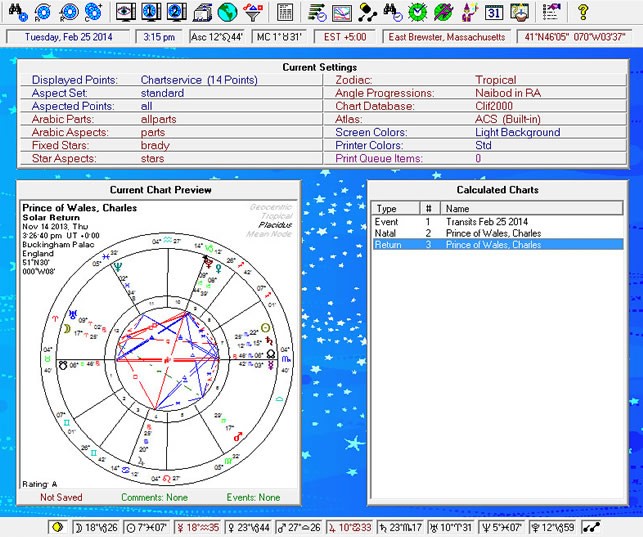
A Solar Return (SR) chart is cast for the exact moment the Sun returns to its natal position, providing a snapshot of the year ahead. The planetary positions and aspects in this chart reveal themes, opportunities, and challenges that will shape the year.
1. Key Planetary Positions
- Sun → Focus of the year, personal goals, and vitality.
- Moon → Emotional tone, inner needs, and subconscious patterns.
- Mercury → Communication, learning, travel, and decision-making.
- Venus → Relationships, love, finances, and aesthetic appreciation.
- Mars → Energy, initiative, motivation, and assertiveness.
- Jupiter → Expansion, growth, opportunities, optimism.
- Saturn → Discipline, lessons, challenges, long-term planning.
- Uranus → Unexpected changes, innovation, freedom.
- Neptune → Dreams, spirituality, imagination, illusions.
- Pluto → Transformation, power, deep personal change.
2. Aspects in the Solar Return Chart
Conjunction (0°)
- Amplifies planetary energies, concentration of focus, can be harmonious or intense.
Opposition (180°)
- Tension, balancing polarities, highlights areas of challenge.
Trine (120°)
- Harmony, ease, natural talents, opportunities without major effort.
Square (90°)
- Challenges, tension, obstacles that require action and growth.
Sextile (60°)
- Opportunities, cooperation, potential that can be developed consciously.
Minor Aspects
- Quincunx (150°), Semi-Square (45°), Sesquiquadrate (135°)
- Subtle energies, internal adjustments, minor challenges.
3. How to Interpret Planets and Aspects in SR
- Identify key planets and their house positions – which areas of life are emphasized?
- Check the aspects – are they harmonious or challenging?
- Compare with natal chart – which themes are reinforced or activated?
- Focus on angular houses (1st, 4th, 7th, 10th) – major life events and external visibility.
✅ Summary
The Solar Return chart is a yearly roadmap. By analyzing planetary positions and aspects, astrologers can predict themes, challenges, and opportunities for the coming year. Harmonious aspects indicate ease, while tense aspects highlight lessons and growth.