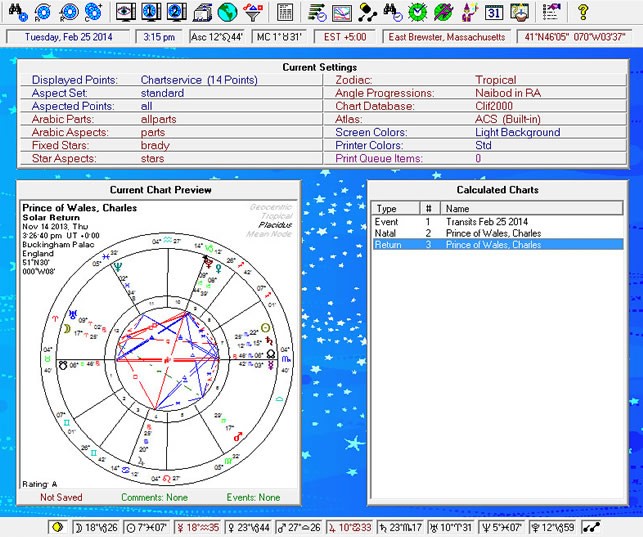
A Solar Return chart (or “Sun Return”) is cast for the moment when the transiting Sun returns to the exact degree and minute of the natal Sun. This chart becomes active from that moment until the next year’s return. It reveals themes, energies, challenges, and opportunities for that year.
Key Principles & Considerations
- The house where the Solar Return Sun falls gives the primary area of life in focus (identity, career, relationships, etc.).
- The aspects the Sun makes to other planets (and vice versa) bring nuance and modifiers: support, tension, growth points.
- The ruler of the Solar Return Ascendant and its placement/aspects are highly significant.
- Intersection with natal chart factors: For example, which natal house the Solar Return Ascendant or Midheaven falls into; natal planets triggered by Solar Return aspects.
- The chart’s angular planets (those near the Ascendant, IC, Descendant, MC) often carry more weight.
- Distribution of planets across hemispheres, quadrants, left/right side, and elemental balance all add interpretative layers.
- Use exactness (orb strength) as a weighting factor: the closer an aspect or conjunction, the more potent its influence.
Step-by-Step Approach to Interpret a Solar Return Sun Return Chart
Here’s a suggested sequence you can use when interpreting:
- Locate the Solar Return Sun
- Identify which house it occupies.
- Note its aspects to other planets.
- See if it is conjunct any angles (Ascendant, Midheaven, etc.).
- Consider the sign it is in and its dignity or debility.
- Examine the Ascendant / Rising Sign
- This sets the tone or “lens” through which the year will manifest.
- Find the ruler of that Ascendant, and see where it lies and what aspects it forms.
- Check Angular Planets & Conjunctions
- Planets on or very near the four angles (AC, IC, DC, MC) act as focal points.
- Conjunctions to these axes or the Sun amplify their influence.
- Review Major Aspects Involving the Sun
- Trines, sextiles, squares, oppositions to the Sun will color how that Sun-house topic functions: ease, friction, transformation, or growth.
- Overlay Solar Return over Natal Chart
- See which natal houses are activated by Solar Return angles or luminaries.
- Pay attention especially to the house in which the Solar Return Ascendant falls in the natal chart and what natal planet gets emphasized.
- Analyze Planetary Distribution & Emphasis
- Are most planets in the upper or lower hemisphere? That suggests focus on external/social vs. internal/private matters.
- Left side (self-initiated) vs. right side (others, external influence) orientation.
- Elemental and modality balances or imbalances show where growth or tension will arise.
- Interpret Aspects between Sun & Personal Planets
- For example, Sun conjunct Mercury might emphasize communication; Sun square Saturn might bring challenges or delays to one’s purpose; Sun trine Jupiter could bring expansion or opportunity in the Sun’s house domain.
- Synthesize All Themes
- Weave together Sun house, Ascendant, key aspects, angular emphasis, and natal overlay to articulate a cohesive narrative for the year.
- Highlight opportunities, risks, lessons, and practical guidance for how to work with the chart rather than be driven by it.
- Optional: Divide the Year into Quarters
- Some astrologers break the year into 4 quarters (first three months, next three, etc.) and relate which parts of the chart dominate in each quarter.
- Use mid-points of transit, lunar phases, or progression overlays to time major events within the year.
Illustrative Examples (Short Samples)
- If the Solar Return Sun lands in the 10th house, the year may emphasize career, public reputation, professional goals, or leadership roles.
- A Sun square Saturn in the Solar Return could point to tests, delays, or responsibilities in the area where the Sun lies; one may need perseverance and restructuring.
- If the Ascendant ruler forms a harmonious aspect to the Sun, the individual may feel more aligned with expressing their identity in the year’s key area.
- Suppose the Solar Return Ascendant falls into the natal 7th house — that suggests that partnerships, relationships, or public interaction will be foregrounded in the year ahead.